If you operate a warehouse, a distribution centre, a port terminal or a manufacturing plant, the forklift is the one machine you cannot afford to get wrong. It is also the machine most likely to be bought on price alone — and then to quietly destroy your operating budget for the next eight years.
This guide is written for importers, fleet managers, equipment distributors and rental companies buying between one unit and a full container load of electric forklifts from China. It covers what you are actually buying, how the specifications map to your operation, where in China these machines come from, which certifications matter in which market, and what to check before you release a deposit.
Table of Contents
I. Introduction: The Chinese Electric Forklift Market
Electric forklifts have moved from “the indoor option” to the default choice for a growing share of material handling worldwide. Three forces drove that shift.
- Regulation. Emissions rules have pushed internal combustion (IC) trucks out of enclosed spaces across Europe and North America. Indoor diesel and LPG use is now restricted or effectively uneconomical in most developed markets.
- Battery economics. Lithium iron phosphate packs have fallen in cost while cycle life has improved, changing the maths on total cost of ownership rather than just upfront price.
- Labour and energy costs. Electric trucks cut fuel spend, need less scheduled maintenance, and fit operations that run to tighter margins per pallet movement.
China sits at the centre of that market. It is the world’s largest producer of forklifts, and electric models now account for the majority of new units sold in the Chinese market by volume. That scale is exactly why sourcing from China works — and exactly why it is easy to get wrong.
There are genuine manufacturers with licensed production, type-tested product and real export experience. There are also trading companies reselling unbranded units with a battery label that will not survive a second shift. Telling them apart is the core skill in this category, and it is what the rest of this guide is about.
II. Types of Electric Forklifts
Forklifts are grouped by the industry-standard class system. It is worth knowing it before you talk to any supplier — the vocabulary alone changes how you are treated.
2.1 Class I — Electric Counterbalance Trucks
The workhorse. A sit-down rider truck with the battery as counterweight, rated typically between 1.0 and 5.0 tonnes. Within this class you will most commonly be quoted 1.5 t, 1.8 t, 2.0 t, 2.5 t, 3.0 t and 3.5 t models.
Two sub-configurations matter:
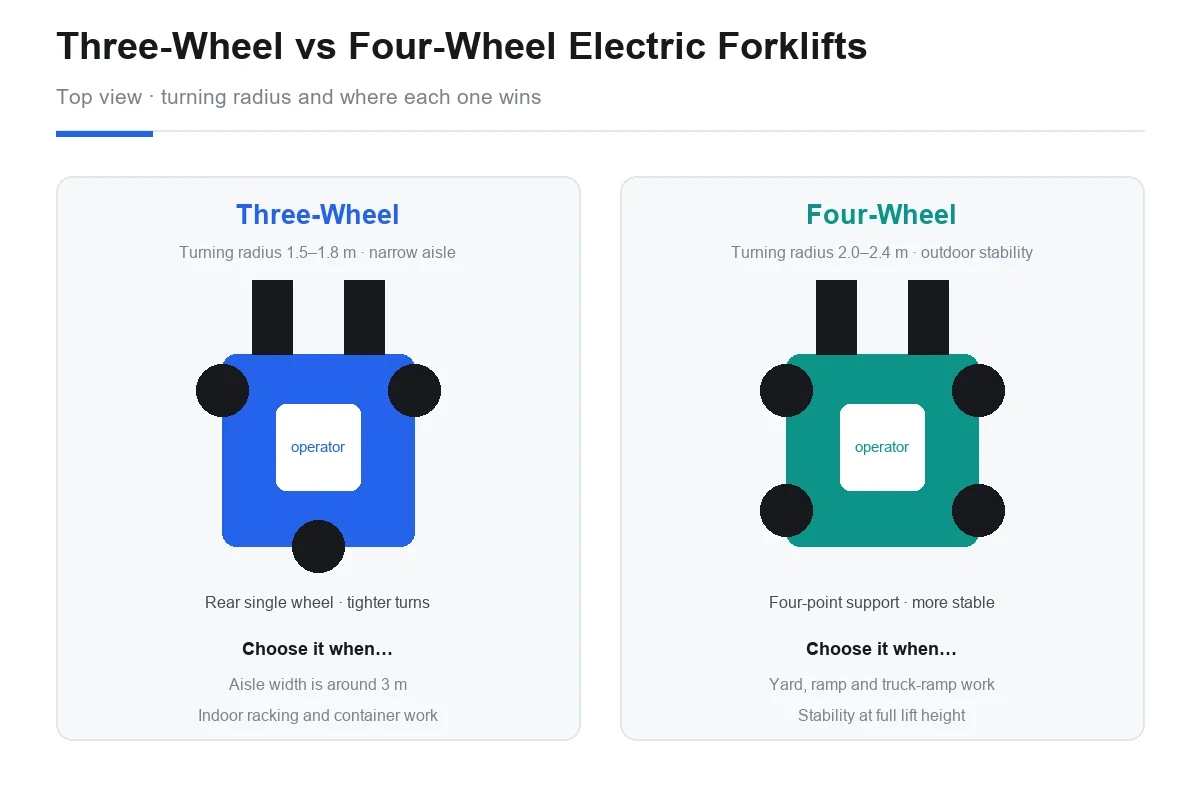
- Three-wheel (3W) — the rear axle pivots, giving a very tight turning radius (roughly 1.5–1.8 m for a 2 t truck) and excellent manoeuvrability in narrow aisles and containers. Less stable at maximum lift height on uneven ground.
- Four-wheel (4W) — more stability and better outdoor performance, at the cost of a wider turning radius (typically 2.0–2.4 m for the same capacity).
If your operation is a 3 m aisle in a distribution centre, the 3W is usually the right answer. If you are handling pallets on a yard, in a port or on a truck ramp, take the 4W.
2.2 Class II — Narrow Aisle and Reach Trucks
Purpose-built for high-density racking: reach trucks, order pickers and turret trucks. These lift to 7–12 m and are the machines that let you increase storage density without adding floor area. They are a specialist purchase — the specification is driven by your rack design, not by a price list.
2.3 Class III — Electric Pallet Trucks and Stackers
Walkie and ride-on pallet trucks, pallet stackers and tow tractors. This is the highest-volume category in the world by unit count, the cheapest per unit, and the most often consolidated into mixed container loads. Capacities run from 1.5 t to 3.0 t for pallet trucks, with stackers typically 1.0–2.0 t.
For a first import, Class III is often the sensible entry point: lower capital, simpler certification, easier shipping and a much faster payback.
2.4 The Power Decision: Lead-Acid or Lithium
This is the single most consequential choice in the whole specification, and it is covered in detail in Section III. In short: lead-acid costs less today; lithium costs less over the life of the truck if your operation runs more than one shift.
Related categories you may want to quote alongside a forklift fleet include hydraulic crawler carriers for heavy loads on difficult terrain, and the wider range of material handling and engineering machinery we source for industrial buyers.
III. Key Specifications and How to Read Them
A forklift quotation without a full specification sheet is not a quotation. These are the parameters that determine whether the machine fits your operation.
3.1 Rated Capacity and Load Centre
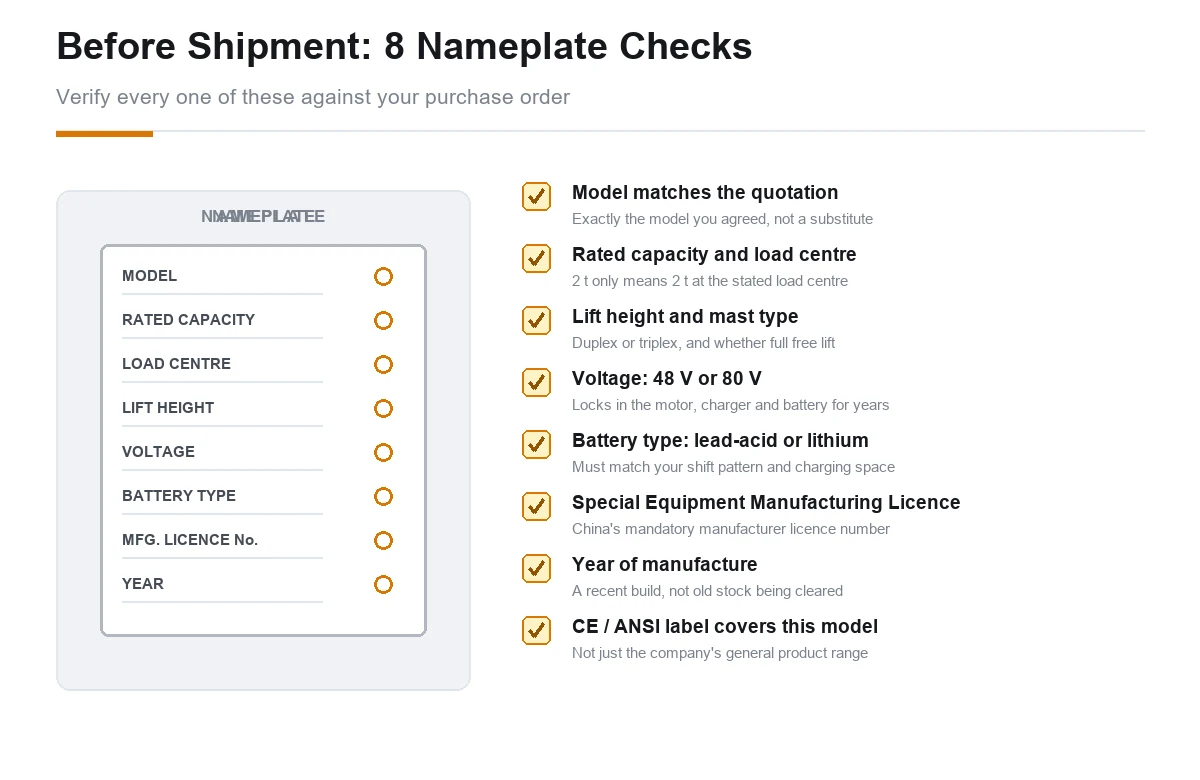
Rated capacity is always quoted at a specific load centre — 500 mm is the international standard, though 600 mm appears on some models. A “2 t” forklift is a 2 t forklift at 500 mm; lift a 2 t load whose centre of gravity sits further forward and the actual safe capacity can drop sharply. Always ask for the capacity derating curve, not just the headline number.
3.2 Lift Height and Mast Type
- Duplex (2-stage) mast — typically 3,000–4,000 mm. Lower cost, better forward visibility, adequate for most single-level racking.
- Triplex (3-stage) mast — typically 4,500–6,000 mm, with full free lift versions reaching higher. Needed for double-deep racking and container loading where the mast must lift before leaving the container.
- Full free lift — the mast can raise the fork carriage without increasing overall height. Essential when working inside a container or under a low door head.
3.3 Battery Voltage and Capacity
- 24 V — Class III pallet trucks and small stackers.
- 48 V — the standard for 1.0–3.5 t Class I trucks. Lead-acid packs commonly 400–625 Ah; lithium packs quoted in Ah or kWh.
- 80 V — 3.5 t and above, heavy-duty and high-throughput operations.
Voltage is not negotiable after purchase: it determines the motor, controller, charger and battery you are locked into for the next decade.
3.4 Motor and Controller
AC motors with AC controllers have replaced DC almost entirely in new electric trucks. They are more efficient, need no brush maintenance, regenerate energy during braking, and handle heat better in continuous duty. If a quote still specifies a DC drive, it is either a very old design or a low-cost machine you should examine closely.
3.5 Dimensional Fit
Three numbers decide whether a truck actually works in your building: overall length (including fork), overall width, and turning radius. Get your aisle width measured before you specify, not after the container arrives.
3.6 Attachments and Options
- Integral side shifter — nearly universal now, worth taking.
- Fork positioner — adjustable spread, useful for varied pallet sizes.
- Clamps, rotators, bale and drum handlers — available, but they change the effective capacity and require a dedicated hydraulic circuit.
- Solid pneumatic vs cushion tyres — pneumatic-style solids for outdoor and rough surfaces, cushion for smooth indoor concrete.
- Cabin, heaters, cold-store specification, non-marking tyres, blue safety spotlights, telematics.
3.7 Specification Overview by Class
| Parameter | Class III Pallet Truck | Class I 3W Counterbalance | Class I 4W Counterbalance | Narrow Aisle (Class II) |
|---|---|---|---|---|
| Typical rated capacity | 1.5–3.0 t | 1.0–2.0 t | 2.0–5.0 t | 1.0–2.5 t |
| Battery voltage | 24 V | 48 V | 48 V / 80 V | 48 V |
| Typical lift height | 0.2 m (lowering only) | 3,000–6,000 mm | 3,000–6,000 mm | 7,000–12,000 mm |
| Turning radius | Hand pallet, n/a | 1.5–1.8 m | 2.0–2.4 m | Aisle-dependent |
| Primary use | Horizontal transport | Narrow aisle, container | Yard, ramp, mixed duty | High-density racking |
| Relative unit cost | Lowest | Medium | Medium–High | High |
3.8 Lead-Acid vs Lithium — the Real Comparison
| Factor | Lead-Acid | Lithium (LiFePO4) |
|---|---|---|
| Upfront cost | Baseline | Commonly 60–100% higher for the battery alone |
| Charge behaviour | 8–10 h full charge plus cooling; battery swapping needed for multi-shift | 1.5–2.5 h fast charge; opportunity charging during breaks |
| Charging infrastructure | Dedicated charging room, ventilation, acid handling, spare battery set | Can often charge at the bay; no swap room required |
| Routine maintenance | Watering, equalising, terminal care | Effectively maintenance-free |
| Cycle life | Roughly 1,200–1,800 cycles; replacement typically every 5–8 years | Roughly 3,000–4,000+ cycles; service life commonly 8–12 years |
| Fleet size impact | Extra batteries and swap logistics often inflate fleet planning | Opportunity charging can reduce the number of trucks a given throughput requires |
| Cold / hot performance | Better tolerance of extreme cold | Performance and charge acceptance degrade in extreme heat without thermal management |
| Transport | Wet cells are classified as dangerous goods | Class 9 dangerous goods; UN 38.3 test summary and MSDS required |
| End of life | Lead recycling is mature and well established | Recycling routes still developing in many markets |
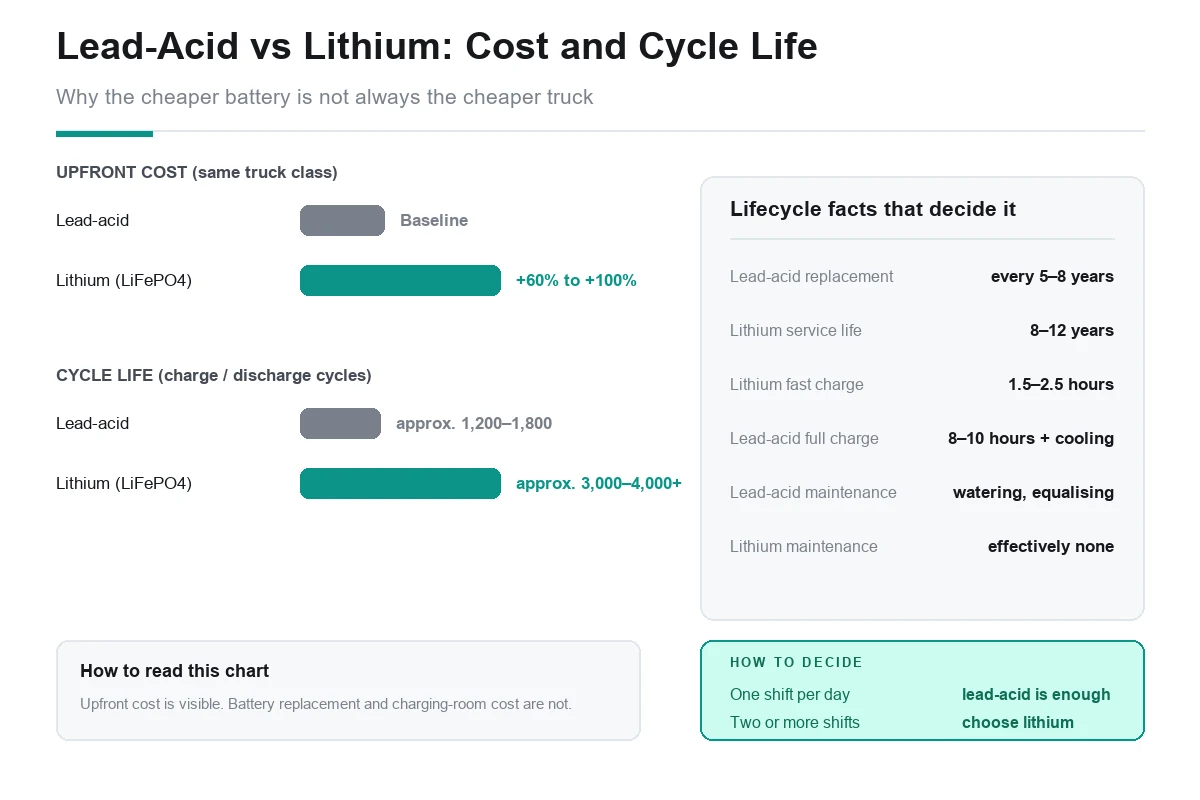
The practical rule most fleet engineers use: one shift per day favours lead-acid; two or more shifts, or no space for a charging room, favours lithium.
IV. China’s Forklift Manufacturing Hubs
Knowing where a supplier actually sits tells you a great deal about what they can and cannot build.
4.1 Anhui Province — Hefei
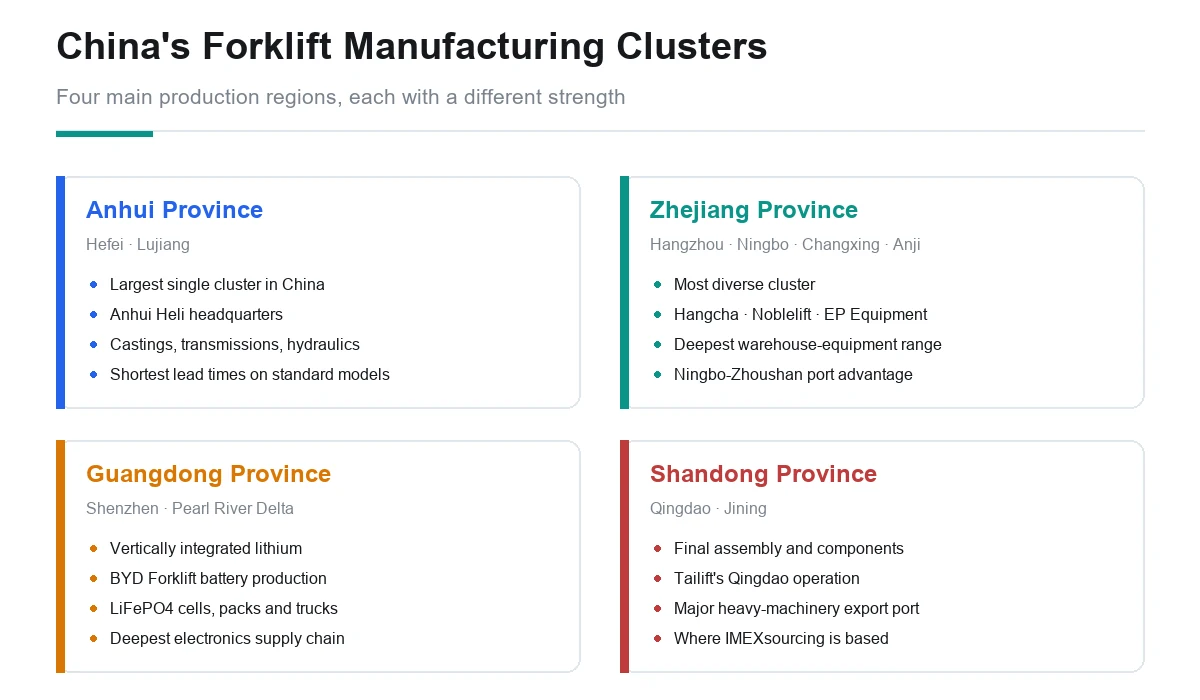
The single largest forklift cluster in China, anchored by Anhui Heli. A deep local supply chain for castings, transmissions, hydraulics and controllers means short lead times and competitive pricing on standard counterbalance models. If you are buying Class I trucks in volume, this is the centre of gravity.
4.2 Zhejiang Province — Hangzhou, Ningbo, Changxing, Anji
The most diverse cluster. Hangcha dominates counterbalance and warehouse equipment from Hangzhou. Noblelift and EP Equipment built their businesses on Class III pallet trucks and stackers from Changxing and Anji. Ningbo adds component and export strength, and the port of Ningbo-Zhoushan makes this cluster very efficient for container exports.
4.3 Guangdong Province — Shenzhen and the Pearl River Delta
Home to BYD’s forklift business and its vertically integrated lithium iron phosphate battery production. If lithium is your priority and you want the battery and the truck from the same source, this cluster deserves attention. Electronics and controller supply in the delta is also the deepest in the country.
4.4 Shandong Province — Qingdao and Jining
A significant base for forklift assembly and components, with Tailift’s Qingdao operation among the better-known names. The practical advantage is the port: Qingdao is one of China’s largest container ports and handles a very high volume of heavy machinery exports. IMEXsourcing is based in Qingdao, which is why factory visits, pre-shipment inspection and container loading here are something we do in person rather than by video call.
4.5 Jiangsu, Shanghai and Liaoning
Jiangsu and the Shanghai area contribute components, electronics and specialist narrow-aisle builders. Dalian in Liaoning retains a long history in heavier and larger-capacity IC and electric trucks.
4.6 One Warning
Clusters also attract traders. Many companies advertising themselves as “forklift manufacturers” in these cities are assembly operations that buy in the chassis, the battery and the mast, then apply a brand. That is not automatically a problem — but it changes what you are buying, how much support you will get and what happens when a part fails in year three. Section VII explains how to tell the difference.
V. Leading Chinese Forklift Manufacturers
The following are established producers with genuine manufacturing operations, export track records and, in most cases, publicly available financial reporting.

One of the two largest Chinese forklift manufacturers and consistently ranked among the top ten material handling equipment producers worldwide. Broadest product range in the country, from Class I counterbalance to heavy IC and warehouse equipment.
Heli’s principal domestic rival, also a global top-ten producer by revenue. Particularly strong in warehouse equipment and the emerging lithium range, with an extensive overseas dealer network.

Vertically integrated lithium iron phosphate (LiFePO4) forklifts, with the cells, packs and trucks produced within one group. A strong argument for buyers who want a single accountable supplier for the whole drivetrain.

A specialist in Class III equipment — electric pallet trucks, stackers and tow tractors — with substantial OEM and ODM volume for international brands.

Founded on lithium-powered warehouse equipment. A useful source for buyers who want modern lithium platforms in Class III without a legacy lead-acid line-up.

Better known for construction machinery than for material handling, Lonking also builds counterbalance IC and electric forklifts and benefits from shared components and dealer infrastructure.

A mid-tier producer with a broad standard range and a long history of export to Europe and Southeast Asia, often competitive on price for mainstream capacities.

Established exporter of pallet trucks, stackers and Class III equipment, with a strong presence in the European market.

Produces in Qingdao, Shandong. Combines IC and electric counterbalance ranges with a well-established export and dealer structure.

One of the oldest Chinese forklift builders, with a long tradition in larger-capacity and heavy-duty trucks.
A note on the list: these are starting points for your own due diligence, not endorsements. Capacities, markets and product quality vary sharply by model line even within the same brand.
VI. Certifications and Compliance
Certification is where a cheap quote becomes an expensive one — usually at the port, after you have already paid.
6.1 Chinese Domestic Regulation — and Why It Matters to You
In China, forklifts are regulated as special equipment (on-site industrial vehicles) under the Special Equipment Safety Law. Manufacturers must hold a Special Equipment Manufacturing Licence, and finished trucks undergo type testing rather than being self-declared.
For a buyer, this is a genuinely useful filter. Asking a supplier for their special equipment manufacturing licence number, and checking that the model on your quotation falls within its scope, separates a licensed manufacturer from a trading company in about two minutes. The relevant product safety standard series is GB/T 10827.
6.2 European Union and the United Kingdom
- CE marking under the Machinery Directive 2006/42/EC. Note that the new EU Machinery Regulation (EU) 2023/1230 replaces the Directive and applies from 20 January 2027 — if you are specifying a fleet for delivery beyond that date, ask how the manufacturer intends to transition.
- EN ISO 3691-1 — safety requirements for self-propelled industrial trucks.
- EN 1175 — electrical and electronic requirements.
- EN 16307 series — supplementary requirements for specific truck types.
- UKCA for the UK market post-Brexit.
6.3 North America
- ANSI/ITSDF B56.1 — the US safety standard for low-lift and high-lift trucks.
- OSHA 29 CFR 1910.178 — governs powered industrial trucks in the workplace, including operator training obligations that sit with you as the employer.
- NRTL listing for chargers and electrical components, where required by your insurer or local authority.
6.4 Other Key Markets
- Australia: AS 2359 series.
- Middle East, Africa and Southeast Asia: requirements vary by country. Some markets require conformity assessment for import clearance (for example PVoC-style schemes in parts of Africa); others rely on CE or ANSI compliance plus the buyer’s own specification.
6.5 Battery and Charger Certification
This is routinely overlooked, and it is the part most likely to stop a shipment:
- UN 38.3 — mandatory test summary for the transport of lithium cells and batteries, together with an MSDS/SDS.
- IEC 62619 — safety requirements for secondary lithium cells and batteries used in industrial applications.
- Charger compliance — CE, UKCA or NRTL as your market requires.
Request certificates for the exact model and battery configuration you are buying, not for the manufacturer’s general product range. A company certificate tells you the company can build a compliant product; it does not tell you that the unit on your order was built to that standard.
VII. Procurement Checklist
7.1 Supplier Sourcing and Selection
- Verify whether you are talking to a manufacturer or a trading company, and price accordingly. Ask for the factory address, the special equipment licence, and the specific models the licence covers.
- Ask for the production line, not the showroom. A short unedited video of your model under assembly at the named factory is more informative than a catalogue.
- Check export history in your market specifically. A supplier who has never shipped to the EU will not have the CE documentation folder you need.
- Ask what their annual volume is for the model you are quoting. A model built ten times a year will have a different spares situation from one built ten thousand times.
- Confirm whether the battery and charger are produced in-house, sourced from a named tier-one supplier, or unbranded. Get the brand in writing.
7.2 Quality Control and Pre-Shipment Inspection
An electric forklift cannot be inspected by looking at it. A meaningful pre-shipment inspection covers:
- Conformity to specification — capacity, lift height, mast type, battery voltage and Ah, tyre type, attachments, paint and decals.
- Functional testing under load — lifting to full height and holding, lowering control, travel and braking, steering, mast tilt, hydraulic leakage, regenerative braking behaviour.
- Battery verification — for lithium, BMS behaviour, charge and discharge cycle test, cell balancing, and the actual usable capacity rather than the nameplate figure.
- Charger function test on your supply voltage and frequency (50 Hz vs 60 Hz is a common and expensive oversight).
- Electrical safety — insulation resistance, earth continuity, emergency stop, seat switch, horn, lights and safety interlocks.
- Documentation pack — operation and maintenance manual in your language, parts catalogue, wiring diagram, warranty statement, and all certificates for the exact model.
- Loading check — correct mast disassembly and reassembly instructions, wheel chocking, strapping, and a photo record of the container as loaded.
7.3 Battery and Charger Decisions
- Decide lead-acid versus lithium before you request quotations. Retrofitting later is technically possible and economically painful.
- If lithium, ask for the cell brand, the BMS brand, the cycle life at your expected depth of discharge, and the warranty in cycles as well as years.
- Specify supply voltage and frequency explicitly on the purchase order.
- Plan the charging infrastructure early. A fleet of electric trucks without adequate charging is a fleet of very expensive storage racks.
7.4 MOQ and Customisation
- Standard models are usually available from one unit. Container-fill quantities attract materially better pricing.
- Customisation commonly available: paint colour, logos and branding, mast height, fork length, attachment type, seat, cabin, telematics and operator display language.
- Mixed loads are normal — forklifts and pallet trucks can often be consolidated with spare parts and other machinery into one shipment.
7.5 Shipping, Logistics and HS Codes
- HS code 8427.10 covers self-propelled trucks powered by an electric motor. IC trucks fall under 8427.20. Parts generally fall under 8431.20.
- FCL is normal: a 20 ft container typically takes two to four counterbalance units depending on model, mast configuration and whether masts are partially disassembled. Class III equipment packs far more densely.
- RORO is a cost-effective option for single large units that roll on their own wheels.
- Battery shipping is the usual bottleneck. Lithium packs are Class 9 dangerous goods and must travel with UN 38.3 documentation; wet lead-acid cells are classified as dangerous goods as well. Many importers choose to ship batteries separately, or to source batteries locally where a service network exists.
- Confirm which Incoterm your supplier is quoting — FOB, CIF or DDP — and what is specifically excluded. Cheap CIF quotes frequently exclude the dangerous goods surcharge on the battery.
7.6 Payment Terms and Warranty
- Common terms are a deposit followed by balance against shipping documents — often quoted around 30/70. Larger orders may justify a documentary L/C.
- Typical warranty is 12–24 months, or a stated operating-hour limit, whichever comes first. Ask what is excluded; battery and hydraulic failures are the two categories most often carved out.
- Confirm the spare parts lead time and the local service option before you sign. On a truck valued in the tens of thousands, a two-month wait for a controller wipes out the savings from the original quote.
Our own quality assurance process is built around these six areas, and we handle freight forwarding including the dangerous goods documentation that battery shipments require.
VIII. Choose IMEXsourcing as Your Electric Forklift Sourcing Partner in China
We are a sourcing and procurement agency based in Qingdao, China, with more than 15 years in the import and export of machinery and industrial products. Forklifts sit squarely in what we do every day.
Engineering-led verification. Our team includes mechanical and electrical engineers, not only sales coordinators. Before we recommend a machine, we read the specification, check the capacity derating curve, verify the battery configuration and confirm that the mast will do what you think it will do in your aisle.
Deep supply chain, not a search engine. Qingdao sits in Shandong Province — the only province in the world with the complete range of 41 major industrial categories. We work directly with established manufacturers across the Anhui, Zhejiang, Guangdong and Shandong clusters, and we tell you plainly which of them are factories and which are resellers.
Strict supplier verification. We audit licences, special equipment manufacturing permits, certifications, production capacity and export history before a supplier reaches your shortlist. If a supplier cannot produce documentation for the exact model, we say so.
Full-cycle quality control and transparent negotiation. Factory audit, pre-production checks, in-process inspection, functional testing under load and pre-shipment inspection — with photographic records at every stage. We negotiate on your behalf with our commercial terms disclosed rather than buried.
Warehouse, consolidation and door-to-door. Our 10,000 m² warehouse in the Qingdao Free Trade Zone gives you up to 60 days of free storage, letting us consolidate forklifts, spare parts, batteries and other machinery from different factories into one shipment. We then handle freight forwarding and the warehouse services that sit between your suppliers and your door.
We do not simply place an order and hope. We stay involved until the trucks are off the vessel and running in your building.
IX. Conclusion
Sourcing electric forklifts from China is a straightforward proposition once the specification is nailed down. The complexity is not in the machine — it is in the choices around it: which class fits your aisle, lead-acid or lithium for your shift pattern, which certifications your market actually enforces, and which supplier can still support the truck in year five.
Get those four decisions right and imported electric forklifts deliver a cost-per-hour advantage that local dealers find difficult to match. Get them wrong and you will spend the savings on batteries, downtime and customs delays.
If you would like a second opinion before you commit — a specification review, supplier shortlist or inspection of a machine already on order — our team is happy to look at the details with you.
Ready to source electric forklifts from China? Tell us your capacity, lift height and shift pattern, and we will come back with a specification review and supplier shortlist.